Visualizing Chemistry One Event at a Time
The Center for Chemistry at the Space-Time Limit (CaSTL) is a multi-institutional NSF Center for Chemical Innovation. Its central goal is to develop the science and technology necessary to directly visualize the inner workings of individual molecules as they undergo chemical change. By tracking structural changes within molecules in real-time, the aim is to capture and control chemistry in the act.
> Learn more
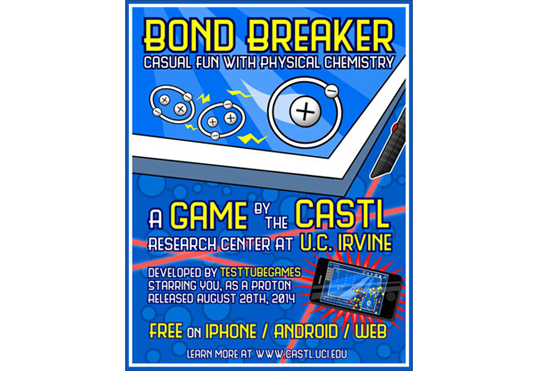
Bond Breaker - A Game Based on CaSTL Research
Pit yourself against atomic physics in Bond Breaker, a new puzzle game based on real nano-scale science. Available here on the web, or on your iPhone and Android devices. You start this game in the smallest way possible - as a single proton. You don’t even have an atom to call your own. Learn what it takes to be a proton, experience subatomic forces, and with luck and determination, grow into an atom of your own. Collide atoms together into molecules, or break them apart again using lasers, tunneling microscopes, and heat. Simply put, this is the most fun you can have without buying your own Scanning Tunneling Microscope!
> Learn more
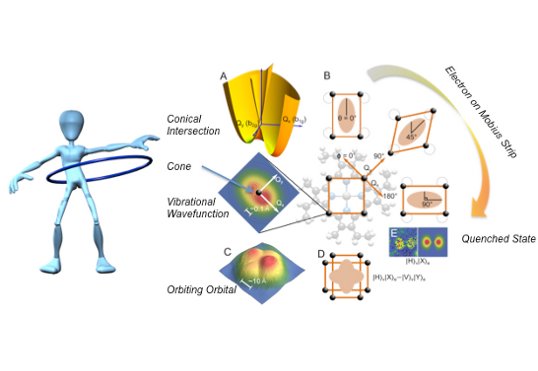
The molecular hula-hoop (Jahn-Teller dynamics) allows direct imaging of a conical intersection
The image of the unpaired electron recorded on a single radical anion shows an orbiting orbital (hoop) driven by pseudo-rotation of the molecular frame (waist). The entangled motion ensures that the vibrational wavefunction (0.1 Å scale) is completely specified by the measured image of the electron (~10 Å orbit).
> Learn more
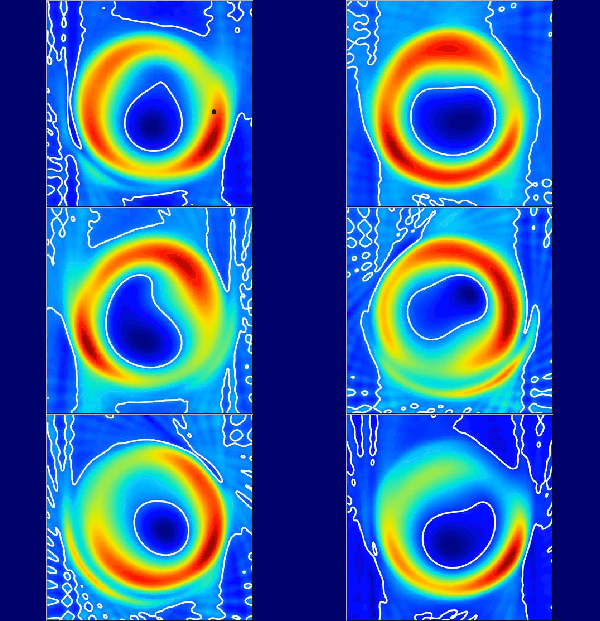
A complete movie of a molecular bond in motion:
The movie is the tomographic reconstruction of the motion of the Br-Br bond in phase space, Wigner distribution function (WDF), at the quantum uncertainty limit of resolution in position and momentum, recorded at a frame every 5 fs. The negative hole in the distribution function (inside white contour) is the unique signature of quantum interference (cattiness of a state).
> Learn more
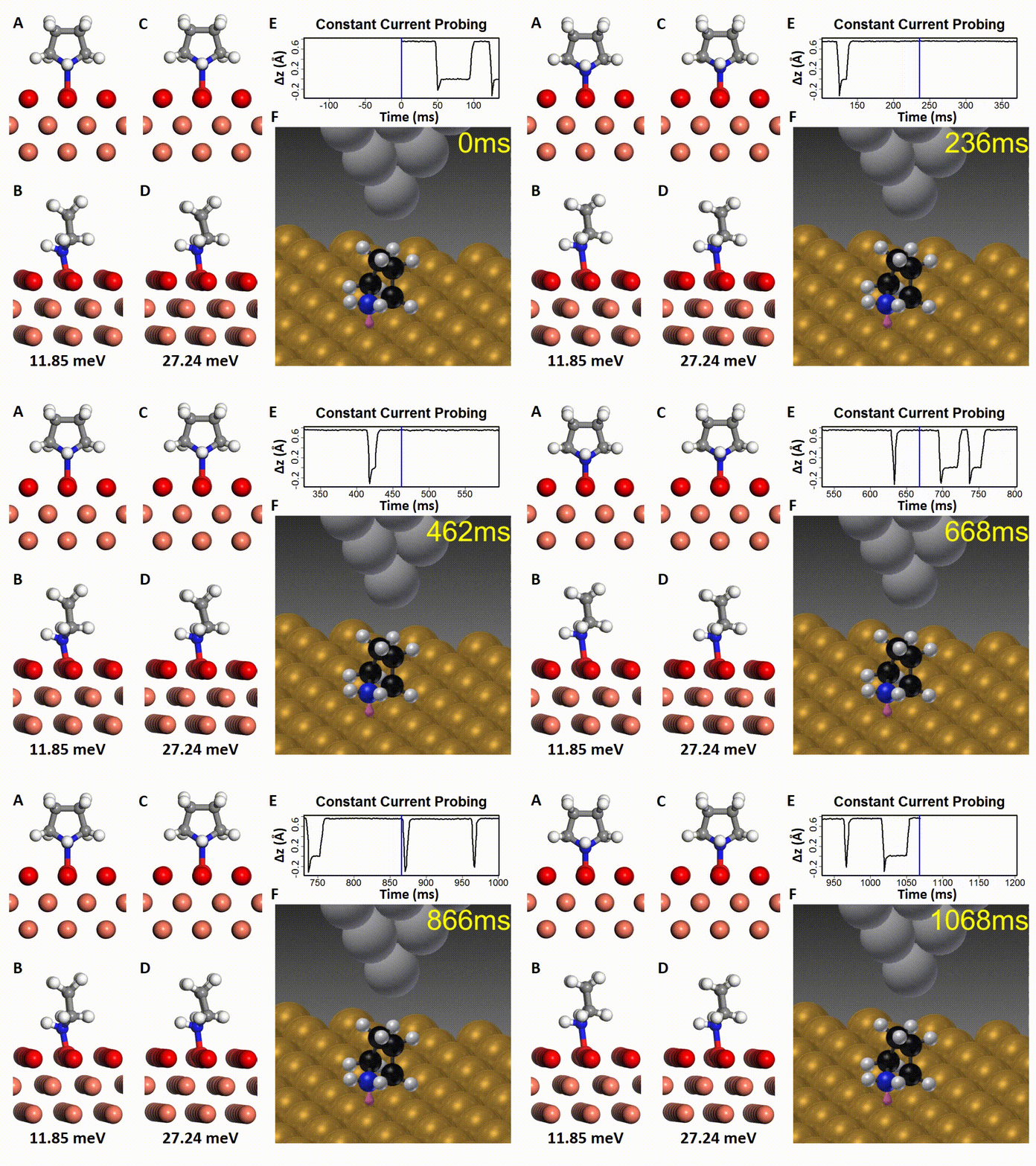
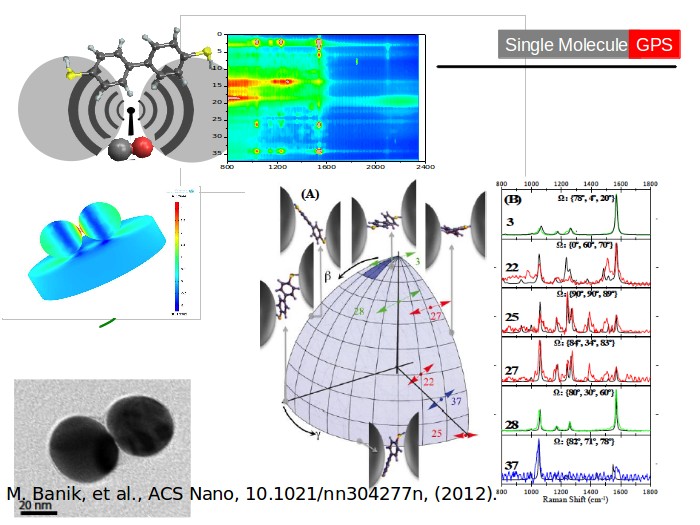
Tracking Structural Transitions of Single Molecules
The image of the unpaired electron recorded on a single radical anion shows an orbiting orbital (hoop) driven by pseudo-rotation of the molecular frame (waist). The entangled motion ensures that the vibrational wavefunction (0.1 Å scale) is completely specified by the measured image of the electron (~10 Å orbit).
> Learn more